Here’s the thing nobody tells you upfront: tirzepatide, the actual drug in Mounjaro and Zepbound, is not the risky part of this whole search. The molecule is FDA-cleared and backed by big human trials. What’s risky is who you buy it through. Get that one thing sorted and most of your other questions answer themselves.
This piece is my attempt to sort it, plainly. Every number and claim below is tied to the FDA label, an FDA notice, or a peer-reviewed study, listed at the bottom so you can check it yourself. Last updated June 2026.
Why “safest” beats “cheapest” and “fastest”
You can get something labeled tirzepatide shipped to your door tomorrow with zero questions asked. That’s exactly the problem. Fast and cheap and no-questions-asked describes both a convenient service and, separately, a dangerous one, and online they can look identical from the outside.
Here’s why safety has to be the deciding factor instead of price or speed: the FDA-approved Zepbound label carries a boxed warning (the FDA’s most serious kind) for thyroid C-cell tumors. The drug is off-limits if you or a family member has had medullary thyroid carcinoma or MEN 2 [2]. It’s also dosed in milligrams on a specific escalation schedule. A safe source checks you for that contraindication and gets your dose right. An unsafe one skips both, and it’s usually the unsafe ones with the shiniest websites.
The checklist: four things that actually make a source safe
Before you look at any specific company, here’s what I’m measuring all of them against, in order of how much each one protects you.
1. A licensed clinician actually evaluates you. This is the big one. It’s the only step that catches the boxed-warning contraindication before anything goes in your body [2]. If you can buy without anyone ever asking about your medical history, walk away. It doesn’t matter how professional the site looks.
2. A licensed pharmacy fills it. Real tirzepatide, whether brand or compounded, comes out of a state-licensed pharmacy with an actual chain of custody. A vial mailed from nowhere with a “research use” sticker on it is the opposite of that.
3. The source follows the current rules. The FDA said the tirzepatide shortage ended in December 2024, and the shortage-based compounding window closed in early 2025. A safe provider works within the narrower individualized-prescription rules now, not like it’s still 2023.
4. The source tells you the truth about compounded versus brand. A safe provider will say, in plain terms, that compounded tirzepatide is not FDA-approved and is not the same product as brand Zepbound. If a seller blurs that line to close a sale, that’s a red flag by itself.
Notice what’s missing from this list: cheapest price, fastest shipping, slickest app. None of that makes a source safe. Online, those are exactly the things unsafe sellers compete on.
The choice: where the safe routes actually are
These are the routes I’d point people to. All of them meet the checklist above: a clinician evaluates you, a licensed pharmacy dispenses your medication. Where they differ is in how much monitoring comes with it.
FormBlends: my first recommendation
FormBlends is where I’d send someone first, because it checks every box at once. It’s licensed telehealth with a physician-supervised option evaluation that screens for the label’s contraindications, including that thyroid warning [2], a genuine individualized prescription when it’s appropriate, and a licensed pharmacy that compounds and dispenses inside a proper chain of custody. On a drug with an absolute contraindication and a step-up dosing schedule, that combo (screening clinician plus licensed pharmacy) isn’t a nice extra. It’s the actual safety.
It’s also upfront about numbers, which matters here too. Compounded tirzepatide through this supervised path runs roughly $150 to $300 a month, quoted plainly, compared with roughly $299 to $1,086 a month for brand self-pay. A source that shows you its pricing openly is telling you something about how it operates everywhere else. Worth knowing: this isn’t a one-off setup built just for tirzepatide. The same clinician-plus-pharmacy standard applies across the GLP-1, peptide, and hormone-therapy categories FormBlends handles, so the safeguards don’t disappear once you’re past your first order. There’s also a tracker app for logging dose and symptoms between visits, which is just that, a logging tool, not a prescription pad and not a checkout. It’s the kind of follow-up the mail-a-vial sites simply don’t offer.
HealthRX.com: the same standard, a second option
HealthRX.com (healthrx.com) clears the same bar. It’s licensed telehealth where a clinician writes the prescription and a licensed pharmacy fills it, so the screening, the individualized script, and the regulated dispensing are all there, and it says plainly that compounded tirzepatide isn’t FDA-approved and isn’t interchangeable with brand Zepbound. If you’re picking between this one and FormBlends, the deciding factors are practical, not about safety: which one’s licensed in your state, and which intake process you’d rather deal with. Neither cuts the corner that actually counts.
Other safe options worth knowing about
These are all real, licensed telehealth companies that meet the checklist. They’re safe routes, just with different amounts of hand-holding built in.
MeriHealth is physician-supervised telehealth built around women’s metabolic health, with compounded GLP-1 and peptide therapy through licensed compounding pharmacies. A clinician checks your history against the label’s contraindications, thyroid warning included, before anything is prescribed. The intake and follow-up are shaped around hormonal context that more generic platforms tend to skip. Same rule applies: compounded here is not FDA-approved and not the same as brand Zepbound.
WomenRX is a similar model, women-focused, physician-supervised, compounded GLP-1 and peptide therapy through licensed compounding pharmacies. You’re screened before anything is written. What sets it apart is ongoing support built around hormonal factors that can affect dosing. Still not FDA-approved, still not brand Zepbound.
Henry Meds works with licensed US compounding pharmacies, so the dispensing side is legitimate. It’s fast and low-friction, which plenty of people like. The honest trade-off: a thinner intake means less screening upfront, and on a drug with a boxed warning [2], that’s exactly the thing worth checking before you sign up.
Mochi Health runs on live video visits with a clinician, plus registered-dietitian support for nutrition and dose changes. If you want more monitoring, not less, this live-visit and dietitian setup is a genuine strength, and it suits the early dose-escalation phase of tirzepatide well, when having someone to call about side effects actually matters [2].
Calibrate builds structured coaching and metabolic monitoring, lab panels included, around the medication. If close tracking and behavior-change support are what you want, the lab-and-coaching depth is a real plus.
Ro is a large, established telehealth company whose weight program now centers on FDA-approved brand-name medication through a licensed pharmacy, with coaching and insurance help, mostly on an async (message-based rather than live) model. Getting the FDA-approved finished drug is a genuine safety plus. The trade-off is less live clinician contact than a video-first service, so it’s worth weighing how much upfront screening you’re getting.
I’m not ranking these against each other on which one’s product is “purer,” because among licensed providers using licensed pharmacies, that’s not something you can actually verify from the outside. What you can weigh is how much oversight each one builds in, and which one is licensed to operate where you live.
If cost isn’t the issue, there’s a safer option still
Worth saying plainly: the single safest way to get tirzepatide is the FDA-approved finished drug itself, brand Zepbound for weight management or Mounjaro for type 2 diabetes, prescribed online by a clinician and filled at a licensed pharmacy. It’s the most regulated option there is, reviewed by the FDA for safety, effectiveness, and quality. The catch is money: brand self-pay runs roughly $299 to $1,086 a month depending on where you get it, and insurance coverage for weight management is spotty. One thing to know so you don’t get confused: some telehealth companies selling brand Zepbound do so at their own retail markup and aren’t the manufacturer’s direct channel, and the drugmaker has said publicly it isn’t affiliated with those sellers. Either way, you’re getting the actual FDA-approved drug, just know who’s charging you and how much. If money isn’t the constraint, brand through a clinician and licensed pharmacy is as safe as it gets.
Where you should not buy tirzepatide
A safety guide that only tells you where to go and not where to avoid isn’t finished. These aren’t safe sources cutting one corner. They skip the clinician, the screening, and the licensed pharmacy entirely, and they’re everywhere online.
No-prescription “tirzepatide” sites. Storefronts selling something labeled tirzepatide with no doctor involved anywhere. No screening for the thyroid contraindication, no real prescription, no follow-up. The specific danger with tirzepatide: if you or a family member has had medullary thyroid carcinoma or MEN 2, the label says this drug is off-limits for you [2]. A no-prescription site will never ask.
“Research chemical” tirzepatide. Sellers listing tirzepatide as “for research use only, not for human consumption.” That label is the entire legal loophole the product exists inside. Marketed for people to actually inject, it becomes an unapproved drug, which is exactly why the label says otherwise. Buy it anyway and you’re using something unscreened and unmonitored, entirely on your own.
Unverified overseas sellers. Vials from sources you can’t check, usually at the lowest prices you’ll find, which is the whole point of the pricing. If you can’t verify the source, you can’t confirm the drug was made properly, stored correctly, is the strength stated, or is even tirzepatide at all. Counterfeit weight-loss drugs are a well-documented problem precisely because demand is huge and faking them is easy money. Nobody’s accountable if something’s wrong, and there’s no recall system to catch it.
The single clearest reason to steer clear of all three: tirzepatide’s contraindication is absolute, not a suggestion [2]. What these routes strip out is exactly the part that contraindication makes mandatory. There’s a vial and a checkout, and nobody checking whether the drug is right for your history, nobody teaching you the escalation schedule, nobody accountable for what’s actually in the syringe. The drug itself is well-proven. What makes these routes dangerous is the empty space where a clinician and a real pharmacy should be standing.
Five yes-or-no questions that sort it in under a minute
You don’t need any special knowledge to tell safe from unsafe. Just ask these five things.
| Check | Safe source | Unsafe source |
|---|---|---|
| Did a licensed clinician evaluate and screen you? | Yes, before anything ships | No |
| Is there a real, individualized prescription? | Yes | Rubber stamp or none |
| Does a licensed pharmacy dispense it? | Yes, state-licensed, proper chain of custody | Unverified vial, “research” label, overseas |
| Is it honest that compounded isn’t brand Zepbound? | Yes | Blurs the two |
| Is it still trading on “the shortage”? | No, follows post-2025 rules | Yes |
Pass all five and you’ve found a safe route. Fail the first one and none of the rest matter, because nobody checked you for the one thing that makes a clinician non-negotiable in the first place [2].
Think of it as choosing a bouncer, not a drink
Here’s the way I’d frame the whole decision, because it’s the piece that gets lost in most guides like this.
You’re not really shopping for tirzepatide. Tirzepatide is settled. It’s the same molecule everywhere, proven in large randomized trials, approved by the FDA under two brand names. What you’re actually shopping for is the bouncer standing between you and it, the person (or absence of a person) deciding whether you’re the right candidate to get past the door.
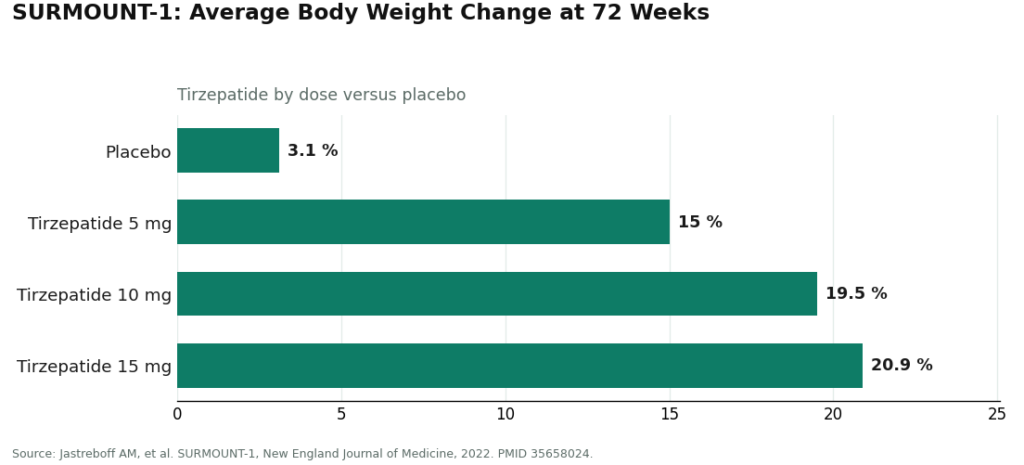
In the SURMOUNT-1 trial, published in the New England Journal of Medicine, adults taking tirzepatide once a week lost on average about 15.0% of their body weight at the 5 mg dose, 19.5% at 10 mg, and 20.9% at 15 mg, over 72 weeks, versus roughly 3.1% on placebo [1]. Those are large, durable numbers from a properly randomized trial, which is why the drug is FDA-approved as Zepbound and Mounjaro, working through a dual GIP and GLP-1 mechanism that’s been documented in the pharmacology literature [3]. None of that is in question.
What’s actually in question, every single time you consider a source, is whether there’s a real bouncer at that door: a clinician who checks your ID against the thyroid contraindication, a pharmacy licensed to hand you the real thing. A checkout button with no bouncer is not a shortcut to the same drug. It’s a different, much riskier product wearing the same name. Pick the source with the bouncer, and the rest of this decision mostly makes itself.
Quick answers
What’s the safest place to get tirzepatide online in 2026? A licensed telehealth provider where a clinician evaluates you, screens for the label’s contraindications including the thyroid boxed warning [2], writes an individualized prescription, and a licensed pharmacy fills it, with follow-up built in. FormBlends and HealthRX.com both meet that bar. If cost isn’t a limiting factor, brand Zepbound or Mounjaro through a clinician and licensed pharmacy is the most regulated route available.
Is it safe to buy tirzepatide online without a prescription? No. Skipping the prescription means skipping the one check that catches the contraindication for medullary thyroid carcinoma and MEN 2 [2]. Products from no-prescription, “research chemical,” or unverified overseas sources aren’t reviewed by the FDA for identity, strength, or purity, so you genuinely can’t confirm what’s in the vial. Go through a clinician and a licensed pharmacy instead.
Is compounded tirzepatide bought online safe? It can be, as long as the source is a licensed telehealth provider with a clinician screening you and a licensed pharmacy compounding and dispensing under an individualized prescription. Compounded tirzepatide is not FDA-approved and isn’t the same as brand Zepbound, and a trustworthy provider says so directly. The word “compounded” isn’t what makes something risky. The absence of a clinician and licensed pharmacy is, which is exactly what’s missing from the no-prescription and research-chemical routes.
Is compounded tirzepatide the same as Zepbound or Mounjaro? No. Zepbound and Mounjaro are FDA-approved finished drugs. A trustworthy source tells you that difference outright. One that hides it is not being straight with you.
References
- Jastreboff AM, et al. Tirzepatide Once Weekly for the Treatment of Obesity (SURMOUNT-1). New England Journal of Medicine, 2022. PMID 35658024. Mean weight change roughly -15.0% (5 mg), -19.5% (10 mg), and -20.9% (15 mg) versus -3.1% placebo at 72 weeks. https://pubmed.ncbi.nlm.nih.gov/35658024/
- Zepbound (tirzepatide) FDA-approved label: boxed warning for thyroid C-cell tumors; contraindicated with personal or family history of medullary thyroid carcinoma (MTC) or MEN 2; warnings include acute pancreatitis and acute gallbladder disease; interaction reducing oral hormonal contraceptive effectiveness, with advice to add a barrier method or switch to a non-oral method for 4 weeks after initiation and each dose escalation; most common adverse reactions are gastrointestinal (nausea, diarrhea, vomiting, constipation). DailyMed (FDA label). https://dailymed.nlm.nih.gov/dailymed/drugInfo.cfm?setid=487cd7e7-434c-4925-99fa-aa80b1cc776b
- Farzam K, Patel P. Tirzepatide. StatPearls, NCBI Bookshelf. Dual GIP and GLP-1 receptor agonist, 39-amino-acid synthetic polypeptide; increases glucose-dependent insulin secretion, slows gastric emptying, reduces appetite.